
logisztika@kiskunhalas.hu
Kiskunhalas
The South Hungary railway junction
We warmly welcome you to Kiskunhalas, the new railway junction of South Hungary. The city’s investor-friendly economic climate, excellent logistical location and modern, new infrastructure opens a new door for investors in the heart of one of Europe’s most dynamically developing regions. From 2025, the city’s new, European-level infrastructure will be the modern railway main line connecting Budapest and Belgrade, two European capitals, whose only railway hub in Hungary will be Kiskunhalas railway station.
Budapest is located about 360 km from Belgrade by rail and 140 km from Kiskunhalas. The junction is only 20 km from the Hungarian-Serbian state border, which is currently also the external Schengen border of the European Union.
The complete reconstruction of the railway line began in 2022 and will be completed by 2025. Within the framework of this development, KIT, the Kiskunhalas Intermodal Railway Loader, will be established in Kiskunhalas, at a strategic location.
The Budapest-Belgrade railway line, including Kiskunhalas, is part of the European TEN-T and RFC corridors. In addition to the two cities, the Balkan Peninsula connects a significant part of Greece with the rest of Europe via a natural geographical route. The corridor starts from the Greek seaport of Piraeus and is joined by the Greek seaport of Thessaloniki. It reaches Belgrade via North Macedonia and Serbia, where traffic from the Montenegrin port of Bar joins the corridor. From Belgrade it continues through Kiskunhalas and Budapest towards Western and Northern Europe.
Within an 80-kilometre radius of the planned railway loader, there are several significant Hungarian and Serbian cities, industrial and commercial centres, which currently do not have any intermodal logistics access by rail. The area is completely uncovered in terms of rail intermodal loader. Until now, outdated infrastructure and the spread of exclusively road transport did not allow the development of the loader, but the situation is changing radically in these years.
The decline in the growth of road transport, the Hungarian-Serbian border, energy prices, the insufficient number of truck drivers, the limit of road capacities and the increase in taxes levied on road transport all foresee the future growth of intermodal logistics.
In Kiskunhalas, the area of the modern, intermodal loader, its railway connection, road connection, utilities, logistics strategy and technical concept plan have already been completed and are available for investors. The loader is currently a prepared investment project waiting for a professional investor.
The real value of the investment in 2023 is EUR 40 million net, its planned timeframe is 3 years, its planned RoI value is 12.5 years, and its planned lifetime is 50 years.
All investor interest is respectfully awaited by the prepared and motivated team of Kiskunhalas Municipality. We’re going, we’re ready.
Logistical situation of Kiskunhalas city
Within an 80-kilometer radius of the city there are significant cities and industries:

- Kecskemét - county seat / one of Hungary's most important industrial cities, characterized by automotive, mechanical engineering and food industry. University town.
- Szeged - county seat / one of the largest cities of Hungary, old university town with significant manufacturing and mechanical industry, technological center. Significant industrial expansions are expected in the future.
- Paks - city, energy centre of Hungary, site of a new nuclear power plant investment, which has significant turnover.
- Baja - city, major Danube port, agricultural logistics centre
- Subotica - a major city in Serbia, Vojvodina Province
Kiskunhalas is located almost equally from the above towns, 50-50 kilometers away. Three main infrastructures are operational or under development in the region:
- M5 motorway, which also connects Belgrade with Budapest and runs 20 km east of Kiskunhalas and is one of Europe's most important transit routes
- MÁV railway line 150, which is currently under reconstruction, will be completed in 2025, passing through Kiskunhalas
- Kecskemét (ICAO: LHKE) is a military airport whose civilian use is under development.
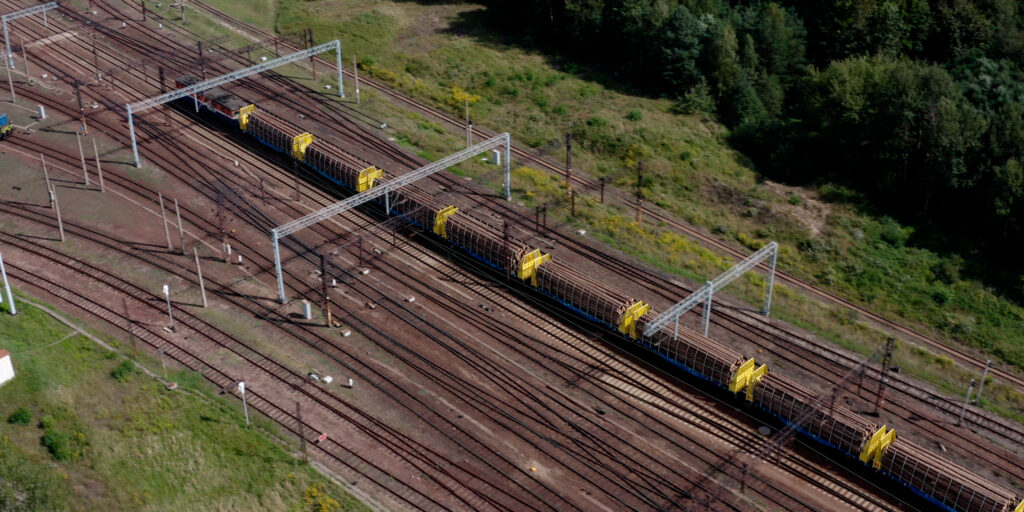
Kiskunhalas alone would not justify the development of an intermodal rail loader, but this European transit environment, the world-class railway infrastructure being developed and the fact that there is no intermodal rail loader in the aforementioned region make it necessary to set up a loader.
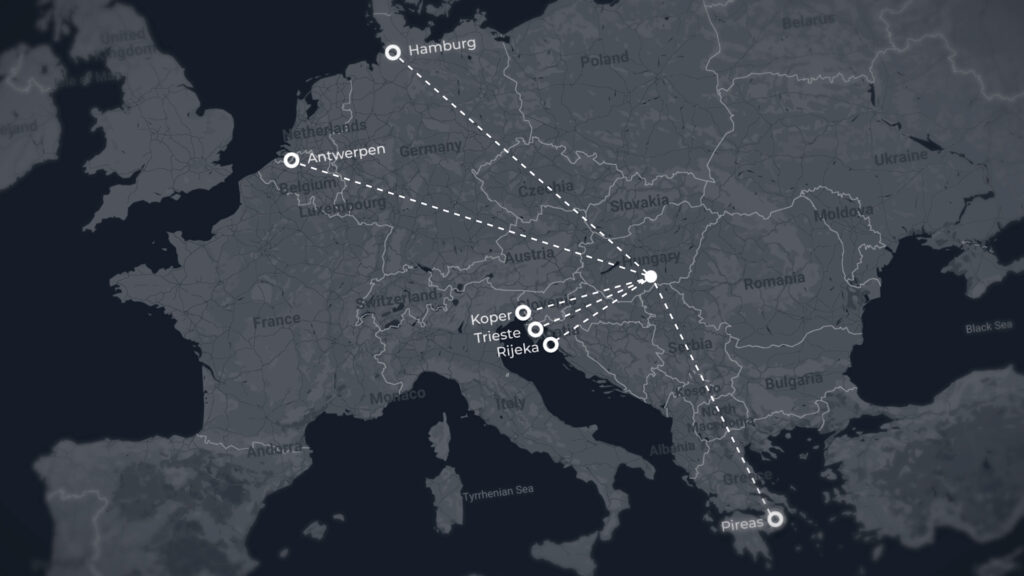
Rail connections to seaports and major European logistical and industrial centres
Adriatic Sea Connection
- KOPER, Slovenia: 24 hours by rail without Budapest
- Trieste, Italy: 28 hours by rail without Budapest
- Rijeka, Croatia: 28 hours by rail without Budapest
- Bar, Montenegro: 36 hours by rail, via Belgrade, on the corridor Kiskunhalas
Aegean Sea Connection
- Pireusz, Görögország: 36 óra vasúton, a korridoron fekszik Kiskunhalas
- Thessaloniki: 33 hours by rail, on the corridor lies Kiskunhalas
Northern Sea Link
- Hamburg / Bremerhaven – 36 hours by train
- Antwerp – 48 hours by rail
North-West Germany, Benelux and UK connectivity
- Huckepack truck trains can reach destinations within 24 hours to and from each other. There is no limit.
Relations between Serbia and the Balkans
- The main goal is to divert the huge truck traffic arriving by road onto the railway, and crossing the border, freight traffic can be connected to rail in Kiskunhalas
The turntable
- Kiskunhalas is located halfway between Hamburg (North Sea) and Piraeus (Aegean Sea) in the middle of Europe, but practically on the border of the European Union.
The Budapest-Belgrade railway development project
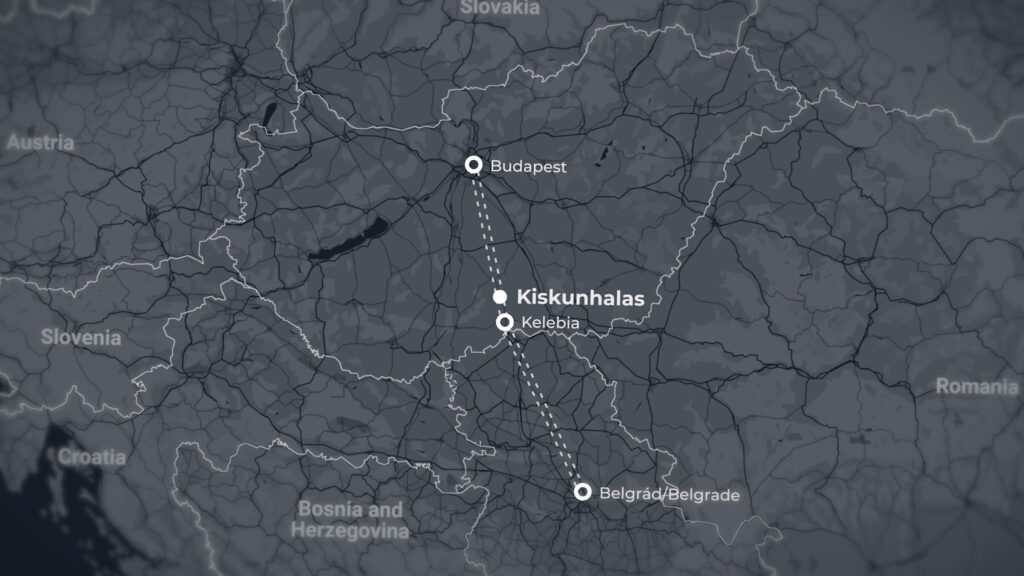
The railway construction will be completed by 2025, within the framework of which:
The railway line connects to the similarly developed Budapest – Vienna main line in Budapest and to the similar, recently commissioned Subotica – Belgrade railway line on the Hungarian-Serbian border.
When commissioned, this new railway line will be one of the most developed railway lines in Europe, with strong corridor traffic.
- 2 main line tracks along the entire length of the railway line,
- 160 km/h rail track speed (100 km/h undisturbed in freight traffic),
- Axle load 225 kN throughout,
- Electrification (standard 25 kV, 50 Hz AC)
- State-of-the-art optical cable securing equipment,
- A new railway station will be built in Kiskunhalas.
- The track gauge is 1435 mm.
Presentation of the Kiskunhalas Intermodal Rail Loading Project
Next to the new railway station in Kiskunhalas, right next to the new Budapest - Belgrade railway main line, the development of a 4-track intermodal loader is being prepared on an area of 25 hectares.
Strategic logistics tasks of the loader:
- Container terminal, turntable for sea containers, container service to the region's economy (there is no container terminal operating within a radius of 140 km).
- Industrial and agricultural loader, there is currently no possibility of industrial or agricultural loading in the region connecting rail and road. The area has significant agriculture, fertilizer arrives by road, grain leaves by road.
- Truck loader, Balkan truck traffic has the opportunity to transport trailers directly from the Hungarian-Serbian border to the United Kingdom by rail, quickly and efficiently, in an environmentally friendly way, saving the road network.
- Automotive loader, the area already has a significant automotive industry (Kecskemét), whose entire ecosystem, such as batteries, metals, car tires, etc. Modern intermodal loading becomes possible.
Plans for the loader logistics and technical concept are already available.
The real value of the investment in 2023 is EUR 40 million net, its planned timeframe is 3 years, its planned RoI value is 12.5 years, and its planned lifetime is 50 years.
Labour demand: 100 people, operation is carried out around the clock, every day of the year.
The city of Kiskunhalas expects primarily a professional investor, and secondly a financial investor or consortium for the development of the loader.
The management of the city is ready to professionally present the technical, logistical, financial investment funds and opportunity of the loader anywhere in the world, in English, in case of a potential investor applicant. Kiskunhalas’ intentions are also supported professionally by Hungary Government.
Why Kiskunhalas?
Facts, arguments
- Kiskunhalas will be one of Europe's most modern railway hubs, right in the middle of a very significant corridor across Europe: the Budapest-Belgrade railway line.
- With a radius of 80 km, there is considerable industry, agriculture and potential, but the nearest intermodal loader is located 140 km away.
- The planned loader is practically located on the Hungarian-Serbian border, on the border of the European Union.
- Significant transit truck traffic will be able to be diverted to rail, trucks entering from the Balkans and Serbia will be able to reach North-West Europe and back by rail within 24 hours.
- The city of Kiskunhalas has prepared the project logistically and technically, the investment area is ready and available. As a 'low cost' investment in intermodal logistics, it can gain a significant strategic position in one of Europe's dynamically developing regions.
- As a 'low cost' investment in intermodal logistics, it can gain a significant strategic position in one of Europe's dynamically developing regions.
- Professional investment advisors, professionals, in case of interest, anywhere in the world, in English, are ready to present the investment opportunity and conduct negotiations.
- Kiskunhalas provides all reasonable support to the investor locally, in the long run, as a reliable partner.
hungarian
English